
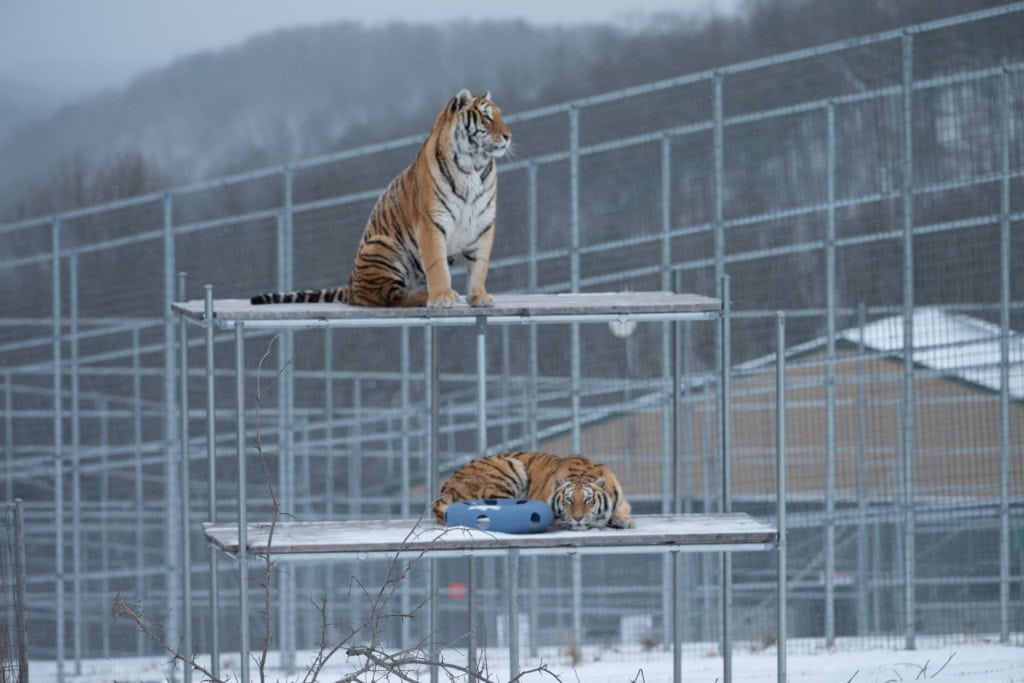
If you’ve ever watched a tiger at Turpentine Creek Wildlife Refuge, you’ve probably noticed how often your eyes are drawn to its tail. It sways, snaps, curls, and lifts, almost like a separate personality. But that long, expressive tail isn’t just decoration — it’s a finely tuned tool shaped by millions of years of evolution.
Here’s what science tells us about why big cats have tails… and why bobcats broke the “long tail” rule.
1. Built-in Balance Bar
A cat’s tail is literally an extension of the spine, made up of a chain of small caudal vertebrae, muscles, and nerves that give it impressive flexibility. Domestic and wild cats use this tail as a dynamic counterweight when walking narrow ledges, climbing, or landing from jumps.
For big cats, this becomes crucial at speed. Studies on cheetahs — the sprinters of the cat world — show that their long, heavy tails act like a rudder and gyroscope combined, helping them stabilize their body and execute sharp turns while chasing prey. Biomechanical modeling and robotic experiments suggest the tail’s sweeping, cone-shaped motion adds enough rotational force to keep the cheetah from toppling over mid-turn.
While our residents at Turpentine Creek may no longer need to chase antelope, their bodies still carry this same “design” — you can see it in the way a tiger flicks their tail to keep balance on rocks or when changing direction at a run in their habitat.
2. A Silent Signal Flag
In big cat society, tails double as communication tools. Like house cats, large felids use tail position and movement as part of their body language.
Because predators rely on stealth, vocalizing too much can blow a hunt or attract unwanted attention. Visual signals like tail language allow big cats to “talk” to cubs, mates, or rivals much more quietly — a vital advantage in the wild.
For keepers at Turpentine Creek, tails are an important welfare clue: changes in tail carriage or movement can hint at pain, stress, or fear long before an animal vocalizes.
3. Sensory “Periscope” and Mood Meter
Research in domestic cats shows the tail is involved in sensing what’s happening behind or brushing against the body, adding to the cat’s near-360° awareness.
Behavioral studies also confirm that tail posture is closely tied to emotional state — from the upright, gently quivering tail of a happy greeting to the puffed-up tail of a frightened or defensive cat.
Big cats appear to follow the same general rules, using tail changes together with ear, eye, and body posture to broadcast how they feel.
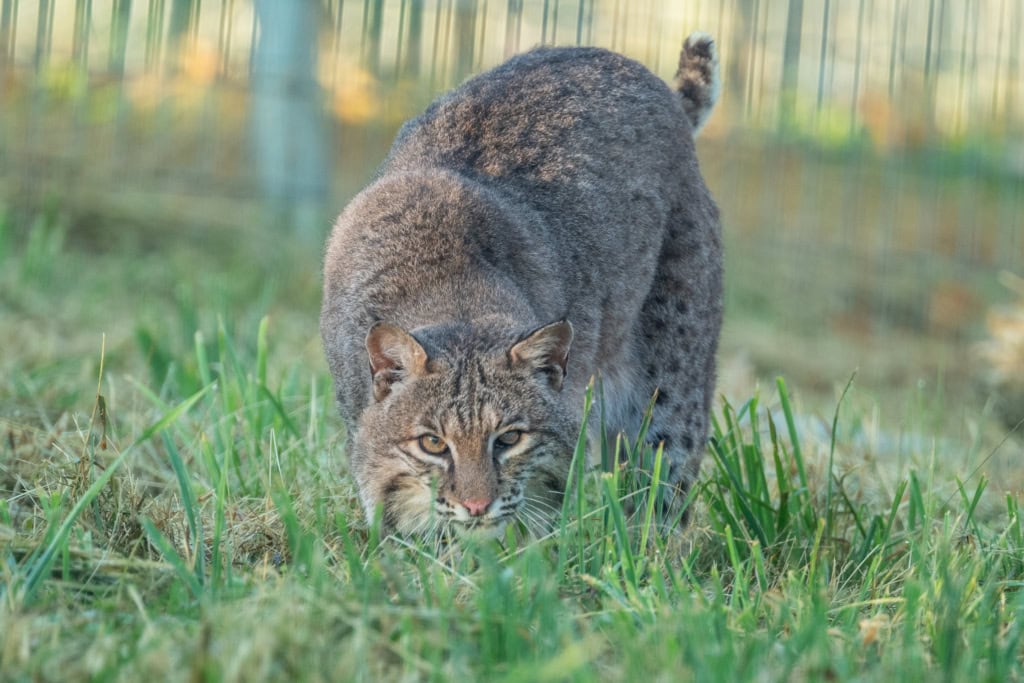
4. So… Why Do Bobcats Have Short Tails?
If tails are so useful, bobcats seem like rebels. Their distinctive “bobbed” tails average only a few inches long — just enough to twitch but nowhere near the sweeping length of a tiger’s.
Scientists don’t have a single agreed-upon answer, but evolutionary biologists point to a few possibilities:
- Habitat and hunting style: Bobcats and their lynx cousins are mostly ground-dwelling ambush predators in dense cover. They rarely need the tight-turning, high-speed chases that benefit from a long tail, so the selection pressure to keep that structure may have weakened over time.
- Neutral mutation: Once shorter tails appeared, they likely didn’t harm survival or reproduction — so the trait persisted and defined the lineage.
What we do know is that bobcats function perfectly well with their compact tails: they run, pounce, and climb efficiently, proving that there isn’t just one “right” design for a feline.
At Turpentine Creek Wildlife Refuge, whether a cat’s tail is long and banded like a tiger’s or naturally short like a bobcat’s, it tells a rich story about evolution, behavior, and wellbeing. Next time you visit, spend a few minutes just watching tails — you’ll be amazed at how much they reveal.