
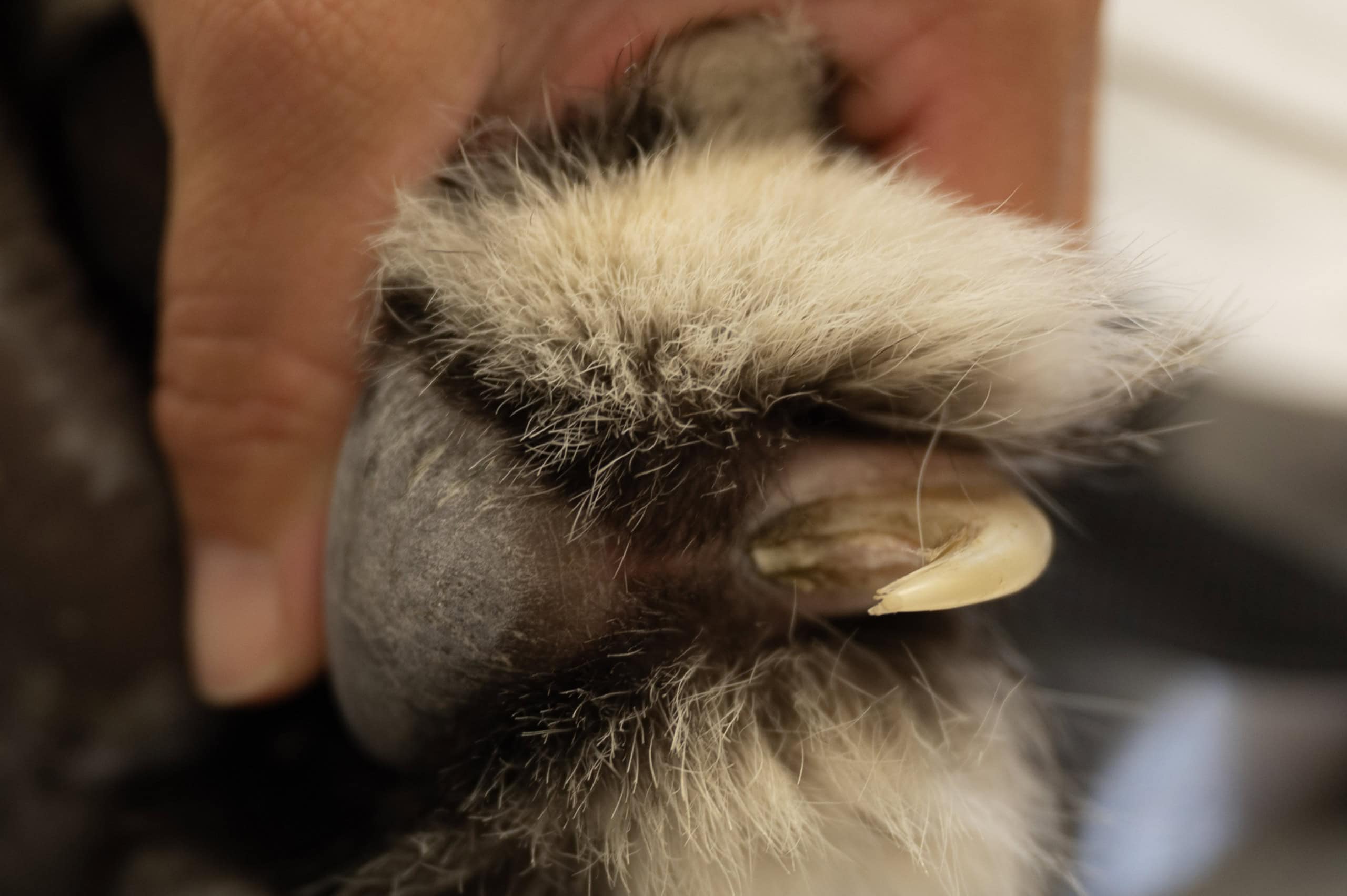
For the majority of the cat family (Felidae), retractable claws are one of their most important tools for survival. When a cat is relaxed or walking, its claws are usually sheathed—hidden inside folds of skin and fur. This does a few crucial things:
- Stealth: With their claws tucked away, cats can move almost silently. There’s no constant clicking against rocks or hard ground, which helps them stalk prey without giving themselves away.
- Protection: Sheathed claws are protected from constant wear and tear. Because they’re only fully unsheathed when needed—for hunting, climbing, or defense—they stay sharper for those critical moments.
- Safety & Mobility: Retracting the claws also helps prevent snagging on brush, grass, or enrichment items. An ambush predator can’t afford to be tripped up right when it needs to leap.
Under the fur, the mechanism is surprisingly complex for something that happens in a split second. Each toe has three small bones (phalanges), similar to the bones in our fingers. The claw grows from the last bone in the toe, and strong elastic ligaments pull that bone—and the claw—backward into a sheath as the toe relaxes.
When a cat wants to extend its claws, it contracts muscles in the leg that tighten tendons running down to the toes. Those tendons pull the last toe bone forward, rotating the claw out of its sheath like a tiny curved knife. The result is a system that gives cats precise control: claws out for gripping, climbing, and hunting; claws in for quiet walking and protection.
For most members of the cat family (Felidae), retractable claws are a defining anatomical feature. In a relaxed state, their claws remain sheathed—tucked within specialized folds of skin and fur. This adaptation serves several biological functions: it minimizes noise during locomotion (critical for ambush predation), protects the keratin structure of the claw from mechanical wear, and reduces the risk of snagging on vegetation or uneven terrain.
Anatomy of Retractable Claws
At the anatomical level, each digit (toe) contains three phalanges—comparable to the bones in a human finger. The claw itself is an extension of the distal phalanx (the last bone). In most cats, a system of elastic ligaments holds the claw in a retracted position when the muscles are relaxed.
When a cat activates its claws, flexor muscles in the forelimb contract, tightening tendons that pull the distal phalanx downward and forward. This motion rotates the claw out of its sheath, allowing it to engage with surfaces for gripping prey, climbing, or defense. This system provides both precision and efficiency—claws are deployed only when needed, preserving sharpness and functionality.
The Cheetah Exception: A Biomechanical Adaptation for Speed
Cheetahs (Acinonyx jubatus) represent a significant evolutionary divergence within Felidae. Their claws are semi-retractable, meaning they remain partially exposed even when the limb is relaxed. Structurally, cheetah claws are shorter, blunter, and less curved than those of other cats, and they lack a fully developed protective sheath.
Function: Traction and Ground Interaction
From a biomechanical perspective, these exposed claws function similarly to track spikes or cleats. During high-speed locomotion, friction between the foot and the ground becomes a limiting factor. By maintaining constant contact with the substrate, the claws increase traction forces, allowing the cheetah to:
- Maximize forward propulsion during acceleration
- Maintain stability at speeds approaching 29 m/s (≈65–70 mph)
- Execute rapid directional changes without slipping
- Decelerate efficiently after a chase
Unlike ambush predators, cheetahs rely on cursorial hunting—pursuing prey over open terrain. At these extreme speeds, even a slight loss of grip could result in failure to capture prey or serious injury. The claws act as part of an integrated locomotor system that includes:
- A highly flexible spine (increasing stride length)
- Enlarged nasal passages and lungs (oxygen intake)
- A long tail (dynamic stabilization and counterbalance)
- Specialized paw pads with ridged surfaces (enhanced friction)
Neuromuscular and Mechanical Integration
During a sprint, a cheetah’s limbs cycle rapidly through phases of contact and suspension. The semi-retractable claws ensure immediate ground engagement upon foot strike, reducing latency between contact and force production. This is critical for maintaining momentum and optimizing ground reaction forces, which directly influence speed and acceleration.
Speed vs. Stealth: An Evolutionary Trade-Off
Most wild cats—lions, tigers, cougars, and smaller species like bobcats—are ambush predators. Their survival depends on silence, concealment, and a short burst of explosive power. Fully retractable claws support this strategy by enabling quiet movement and preserving sharpness for gripping prey.
Cheetahs, however, evolved under different ecological pressures. In open savannas with limited cover, success depends on speed rather than stealth. As a result, their claw structure reflects a trade-off:
- Reduced stealth (due to constant claw exposure)
- Increased traction and stability during high-speed pursuit
This illustrates a key principle in evolutionary biology: anatomical traits are shaped by function and environment. Even within a single family like Felidae, small structural differences can reflect vastly different survival strategies.
Why Claws Matter
Claws are not just tools for hunting—they are integral to a cat’s entire musculoskeletal system. They contribute to balance, locomotion, climbing, stretching, and even communication through scent marking.
Removing them (declawing) is not a cosmetic procedure—it is the amputation of the distal phalanx. This disrupts normal biomechanics, alters weight distribution, and can lead to chronic pain, joint stress, and long-term behavioral changes.
For species like cheetahs, whose entire hunting strategy depends on traction and precise limb mechanics, claw function is even more critical. Their semi-retractable claws are a clear example of how anatomy and function are tightly linked—each adaptation supporting survival in a specific ecological niche.
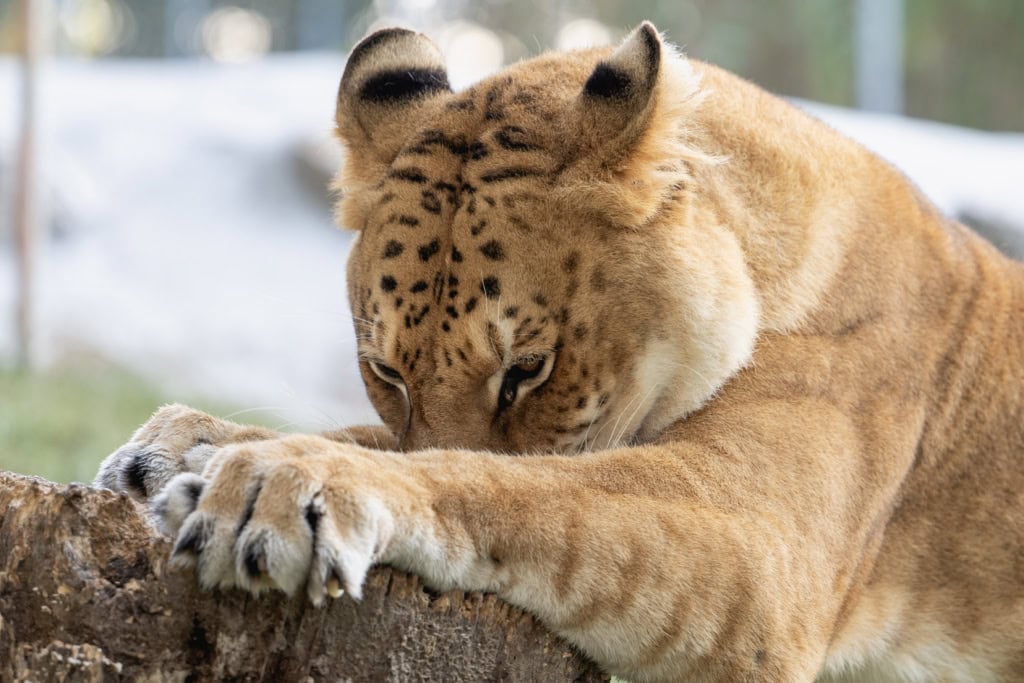
Why Claws Matter—And the Harm of Declawing
At Turpentine Creek, claws are never something to “fix” or remove—they are a vital part of a cat’s anatomy and identity. A cat’s claws are essential for balance, movement, climbing, stretching, defense, and even communication through scent marking. Removing them is not a simple cosmetic procedure—it is an amputation. Declawing involves removing the last bone of each toe, permanently altering how a cat walks and distributes weight.
For wild cats, the consequences are especially severe. Without claws, they lose their ability to grip surfaces, defend themselves, and engage in natural behaviors. Over time, this unnatural gait places stress on joints, often leading to chronic pain and early-onset arthritis. As these animals age, that strain can become debilitating, affecting their mobility and overall quality of life.
Declawing also frequently leads to long-term behavioral issues, including anxiety and defensive aggression, because the animal has lost one of its primary tools for interaction and security. In ethical wildlife care, preserving the full anatomy of these animals is essential—not only for their physical health, but for their psychological well-being.
At Turpentine Creek, claws are never something to “fix” or remove—they’re an essential part of who these animals are. Declawing (which actually removes the last toe bone along with the claw) can cause lifelong pain, balance problems, and behavioral issues, and it has no place in ethical animal care.
Instead, caregivers support the cats’ natural behavior:
- Habitats are designed with logs, trees, platforms, and varied terrain so cats can scratch, stretch, climb, and exercise their claws safely.
- Olders cats or those with medical challenges have their claws monitored closely during regular veterinary care.
- Education programs help visitors understand why claws are so important—and why wild cats should never be kept as pets.