
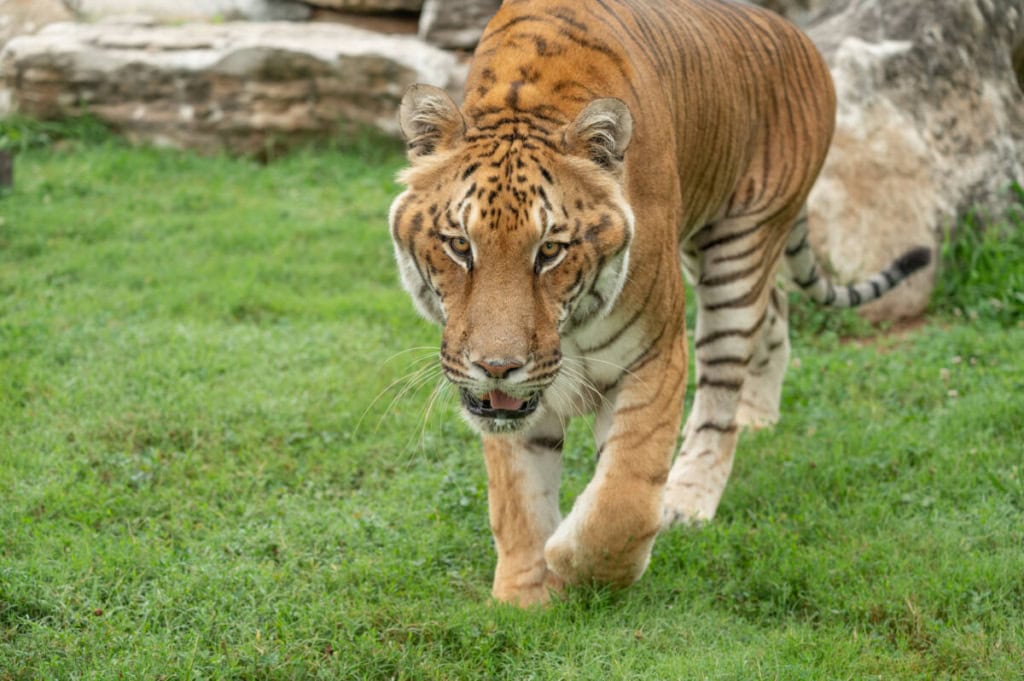
A lion’s yawn. A tiger’s stretch. The quiet stalk of a leopard through tall grass. Even the way your house cat freezes before pouncing on a toy can feel strikingly familiar. It’s no coincidence. Every cat—from the one curled up on your couch to the largest predator at Turpentine Creek Wildlife Refuge—shares an ancient evolutionary heritage. Yet despite these remarkable similarities, there is one important distinction that science makes very clearly: not every large feline is considered a “big cat.” Understanding what defines a true big cat—and what separates lions, tigers, leopards, and jaguars from the domestic cats we know so well—reveals just how extraordinary the entire cat family truly is.
What Makes a “Big Cat” a Big Cat?
People often use the phrase big cat to describe any large feline, but scientifically, the term has a much more specific meaning.
In zoology, the true “big cats” belong to the genus Panthera, which includes:
- Lion (Panthera leo)
- Tiger (Panthera tigris)
- Leopard (Panthera pardus)
- Jaguar (Panthera onca)
- (Snow leopards, Panthera uncia, are also members of the genus Panthera, although they have unique vocal anatomy and do not produce the classic roaring vocalization.)
Domestic house cats, meanwhile, belong to an entirely different genus: Felis catus
Different Size. Same Family.
At first glance, it may seem hard to imagine that a lion and the cat sleeping on your couch are related. Yet scientifically, they belong to the same biological family: Felidae—a group that includes more than 40 living species of wild and domestic cats.
That shared ancestry explains why they look and behave so similarly. But despite these common traits, they are not the same species—or even the same genus. Domestic cats are classified as Felis catus within the genus Felis, while lions (Panthera leo), tigers (Panthera tigris), leopards (Panthera pardus), and jaguars (Panthera onca) belong to the genus Panthera. Although they share a common evolutionary history, these lineages diverged millions of years ago, each adapting to different environments, prey, and ecological roles.
If you’ve ever watched your cat stalk a toy mouse across the living room, you’ve witnessed many of the same instincts a tiger uses in the wild.
Every member of the family Felidae is an obligate carnivore, meaning they evolved to survive almost entirely on meat. Their bodies are remarkably specialized for hunting, with forward-facing eyes that provide excellent depth perception, powerful jaw muscles, retractable claws (with the notable exception of cheetahs), flexible spines that generate explosive bursts of speed, and highly sensitive whiskers that help them detect objects and movement—even in near-total darkness.
Whether it’s a 10-pound house cat or a 450-pound tiger, these fundamental adaptations have changed surprisingly little over millions of years of evolution. While the size, strength, and ecological role of each species may differ dramatically, the blueprint of a cat remains unmistakably the same.
They Sleep…A Lot
One of the biggest similarities surprises many visitors.
Cats are experts at conserving energy.
A domestic cat typically sleeps 12–16 hours each day, while lions often sleep 16–20 hours and sometimes even longer.
Why?
Cats evolved as ambush predators rather than endurance hunters. Instead of chasing prey over long distances like wolves, cats rely on explosive bursts of speed. Sleeping allows them to conserve energy until the next opportunity presents itself.
At Turpentine Creek, visitors sometimes wonder why a lion is sleeping during the afternoon.
The answer is simple:
That’s exactly what healthy lions do.
Every Cat Is a Hunter
Watch a kitten hiding behind the couch before pouncing on your feet.
Now picture a jaguar waiting silently along a riverbank.
The scale is dramatically different—but the behavior is almost identical.
Cats use:
- stalking
- patience
- camouflage
- precise timing
- explosive acceleration
Unlike pack hunters such as wolves, most cats are solitary hunters that rely on stealth instead of teamwork.
Even lions—well known for living in prides—still depend on these same instincts during a hunt.

Whiskers Are Precision Instruments
Those long whiskers aren’t just adorable.
They’re highly specialized sensory organs.
Whiskers detect tiny changes in air movement, helping cats determine whether they’ll fit through an opening, locate nearby objects in darkness, and even sense movement around prey.
Whether it’s a leopard navigating dense forest or your cat walking through a dark hallway, whiskers provide information that eyesight alone cannot.
Their Eyes Work the Same Way
Have you ever noticed that big cats have round pupils while smaller cats have slit-shaped pupils?
That reflection comes from a layer behind the retina called the tapetum lucidum.
This reflective layer allows more light to reach the retina, dramatically improving night vision.
Big cats possess this same adaptation.
Lions, leopards, jaguars, and tigers are all capable of seeing in remarkably low light—one reason they are such successful predators during dawn, dusk, and nighttime hours.
They Communicate in Familiar Ways
Many visitors are surprised to discover how many facial expressions they recognize while watching our residents.
Cats communicate through:
- ear position
- tail movement
- facial muscles
- body posture
- vocalizations
- scent marking
A flattened ear means something very similar whether you’re looking at a tiger or your house cat.
So does a twitching tail.
The language is ancient.
Then Why Can’t My House Cat Roar?
One of the biggest differences lies in the voice.
Members of the genus Panthera possess specialized anatomical adaptations in their larynx and hyoid apparatus that allow them to produce deep, resonating roars. Lions, tigers, leopards, and jaguars can all roar, although each species sounds distinctly different. Modern research shows that specialized elastic vocal folds—working with differences in the hyoid region—play an important role in producing these powerful vocalizations.
Domestic cats cannot roar.
Instead, they purr.
For many years scientists believed roaring and purring were determined solely by differences in the hyoid bone. Today, researchers know the anatomy is more complex, involving the vocal folds and surrounding structures of the larynx.
Big Cats Aren’t Just Bigger House Cats
Despite these similarities, the differences are just as important.
A tiger isn’t simply an oversized tabby.
Big cats evolved to fill the role of apex predators, shaping entire ecosystems.
Consider just a few differences:
| House Cat | Panthera Big Cats |
|---|---|
| Usually 8–12 pounds | 100–600+ pounds depending on species |
| Small prey like rodents and birds | Deer, wild pigs, buffalo, antelope, caiman and other large prey |
| Small home territory | Territories that may span dozens to hundreds of square miles |
| Domesticated over thousands of years | Wild animals that have never been domesticated |
| Live comfortably alongside people | Require specialized habitats and should never be kept as pets |
Perhaps the most important distinction is this:
Domestic cats have been selectively bred over thousands of years to live alongside people. Big cats have not.
No matter how calm a lion may appear, or how playful a tiger seems, they remain wild animals with instincts shaped by millions of years of evolution.
That instinct never disappears.
Why This Matters
At Turpentine Creek Wildlife Refuge, nearly every lion, tiger, leopard, and jaguar arrived because someone underestimated that reality.
Many were bred for private ownership, entertainment, roadside zoos, or the exotic pet trade. Some were purchased as cubs, only to become too large, too powerful, or too dangerous to manage as adults.
While these animals may share many behaviors with the cats curled up on our couches at home, they are fundamentally different in one critical way:
They belong in professional, accredited care—not private ownership.
Understanding what makes big cats similar to domestic cats helps us appreciate how remarkable they are.
Understanding what makes them different helps protect them.
Wild at Heart
The next time your house cat stalks a feather toy, hides inside a cardboard box, stretches after a nap, or quietly watches birds through the window, remember:
You’re seeing behaviors that connect your companion to one of Earth’s most extraordinary families of predators.
From the smallest house cat to the largest tiger, every member of the cat family carries the legacy of a remarkable evolutionary history.
At Turpentine Creek Wildlife Refuge, we’re privileged to care for animals that remind us every day that although captivity may have shaped their past, their instincts remain exactly as nature intended.
Because whether they’re eight pounds or five hundred…
They’re still wild at heart.