
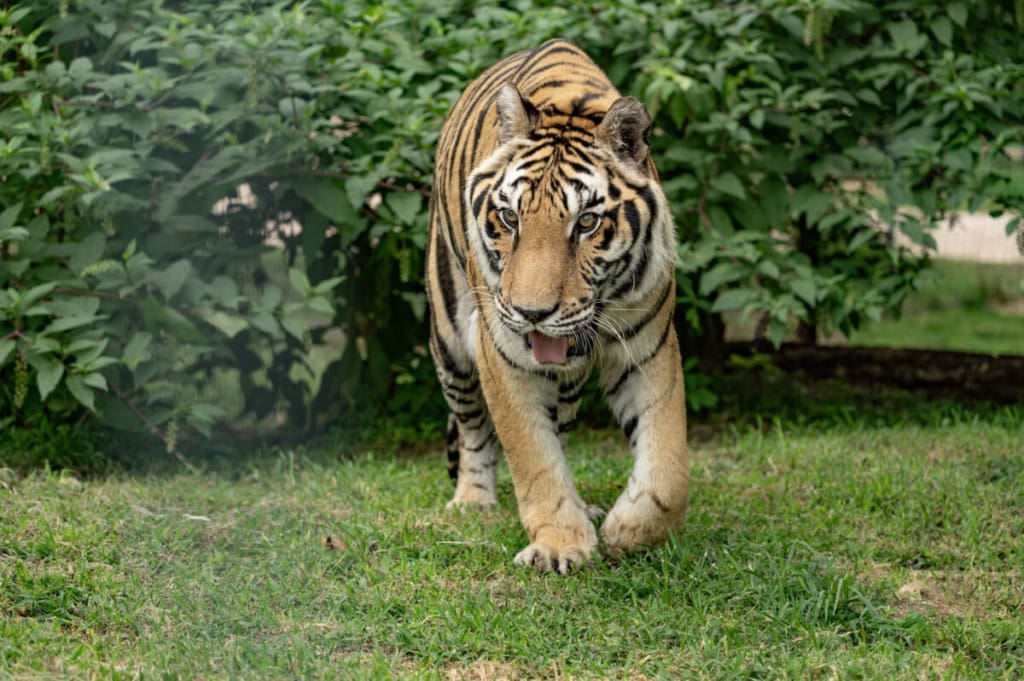
The fatal tiger attack in Yorkshire, England, exposes a dangerous misconception about big cats—and why respecting their wild instincts is essential to protecting both people and animals.
On October 10, 2026, a tragic incident unfolded at Yorkshire Wildlife Park in England when a man entered the enclosure of an Amur tiger named Altai. Within minutes, the encounter turned fatal. Despite emergency responders’ efforts, the man died at the scene. The incident has left a family grieving, a community shaken, and an important conversation about the dangers of big cats at the forefront.
At Turpentine Creek Wildlife Refuge, where we have spent more than three decades rescuing big cats from abuse, neglect, and exploitation, the tragedy reinforces a message we have shared since our founding: No matter how accustomed a tiger becomes to people, it remains a wild animal.
Your House Cat Has Claws. A Tiger Has the Power to Kill.
Anyone who has shared their home with a domestic cat understands how quickly feline behavior can change. One moment, your cat may be peacefully resting beside you, enjoying attention. The next, a sudden movement, unexpected sound, or unwanted touch can trigger a swat, bite, or defensive reaction.
Now imagine that same unpredictability in an animal weighing 400 to 600 pounds, equipped with enormous canine teeth, powerful jaws, and claws capable of inflicting catastrophic injuries in seconds.
The difference is that your house cat has undergone thousands of years of domestication. Tigers have not.
Even when born in captivity, bottle-fed by humans, or raised around people, tigers retain the instincts of wild predators. Their responses are shaped by territorial behavior, stress, fear, learned experiences, and environmental stimuli. Captivity can further complicate their behavior, particularly when animals have experienced improper socialization, confinement, or abuse.
A tiger that appears calm is not necessarily safe. A tiger that tolerates human presence has not given permission to be touched. And a tiger that has never attacked someone is still capable of killing.
The Dangerous Illusion Created by Roadside Zoos
Unfortunately, the public’s understanding of big cats has been distorted by decades of roadside zoos, private ownership, and pseudo-sanctuaries that exploit these animals for entertainment.
Photographs of people cuddling tiger cubs, swimming alongside big cats, or posing with adult predators create a dangerous illusion: that these animals can form relationships with humans similar to those of domestic pets.
What those photographs don’t reveal is the exploitation often occurring behind the scenes.
Cubs may be separated from their mothers, subjected to constant handling, and treated as attractions rather than wild animals with complex behavioral needs. When they become too large and dangerous for public interaction, they may be discarded, sold, or used for breeding.
These facilities don’t simply endanger visitors. They teach the public to misunderstand the very animals they claim to celebrate.
As TCWR’s Scott Smith explains:
“People have unrealistic expectations regarding big cats, which is why we passed the Big Cat Public Safety Act in the US. However, that does not stop maniacs from doing crazy things!”
The Big Cat Public Safety Act, signed into law in December 2022, prohibits public contact with big cats and restricts private ownership in the United States. It represents a major victory for animal welfare and public safety, but legislation alone cannot eliminate the misconceptions that decades of exploitation have created.
The Tiger Should Not Pay for Human Decisions
While the loss of human life in Yorkshire is heartbreaking, there is an important distinction that must not be overlooked.
Altai did not escape his enclosure to attack someone. A person entered the tiger’s habitat, crossing the protective barriers designed to keep both humans and animals safe.
The tiger responded as a powerful wild predator might when confronted with an unfamiliar person in his environment.
Following the incident, Yorkshire Wildlife Park confirmed that Altai was unharmed and would not be euthanized.
TCWR’s Emily McCormack expressed relief at that decision:
“We are very happy the tiger will not have to pay a price for human ignorance“
Too often, wild animals suffer the consequences of human decisions. Whether through private ownership, forced interactions, inadequate enclosures, or reckless encounters, the animal is placed in circumstances it never chose.
When tragedy follows, we must recognize the difference between an animal acting according to its nature and the human decisions that created the dangerous situation.
Respecting Wildlife Means Keeping Our Distance
At Turpentine Creek Wildlife Refuge, our animal care team works with some of the world’s most powerful predators every day. Yet our staff never share unrestricted space with our big cats.
Our safety protocols, protected-contact practices, secure habitats, and carefully managed animal movements exist for a reason. Even the most familiar resident, one our caregivers have known for years, deserves to be treated with the same caution and respect as a newly rescued tiger.
We do not mistake familiarity for domestication.
True sanctuaries do not offer tiger selfies, cub-petting encounters, or opportunities to enter enclosures with dangerous predators. They provide lifetime care, appropriate habitats, behavioral enrichment, veterinary treatment, and the opportunity for rescued animals to live without being exploited for human entertainment.
The tragedy in Yorkshire is a painful reminder of why those standards matter.
Our hearts go out to the family of the man who lost his life, the witnesses, and the wildlife park staff affected by this devastating event.
But we also hope this tragedy inspires a greater understanding of the animals themselves.
Tigers do not need our affection, our embraces, or our photographs. They need our respect.
And sometimes, the most meaningful way to show our love for wildlife is to recognize the boundaries that should never be crossed.
Learn more about our mission of Rescue to Refuge and the importance of true sanctuary at TurpentineCreek.org.