
When the air turns sharp and frosty, many animals quietly pull off one of nature’s greatest wardrobe tricks: they grow a winter coat. Fur thickens, feathers fluff up, and in some cases, their entire color changes from brown to brilliant white.
At Turpentine Creek Wildlife Refuge, we see our big cats shift with the seasons too — trading sleek summer coats for dense winter fluff. But what’s actually going on under all that fur? Let’s look at the science behind winter coats, and why they matter so much for animals in the wild and in sanctuary care.
What Is a “Winter Coat,” Exactly?
A winter coat isn’t just “more fur.” It’s a carefully timed remodel of the entire outer layer:
- Thicker undercoat: Many mammals grow a dense layer of short, fine hairs close to the skin. This traps air — a fantastic natural insulator.
- Longer guard hairs: The outer hairs can grow longer and sometimes coarser, helping shed snow and rain.
- Different texture or oiliness: Some species produce more skin oils in winter, which helps waterproof the coat and protect the skin.
Birds do something similar by molting — replacing older feathers with new, better-insulating ones, and fluffing them up to trap warm air close to their bodies.
How Do Animals Know It’s Time to Change?
Most animals don’t wait until they’re shivering to start growing a winter coat. By then, it would be too late. Instead, their bodies respond to day length, or the number of hours of light in a day.
As autumn approaches and days get shorter, the amount of light received by an animal’s eyes decreases. This signals the brain, which adjusts hormone levels, such as melatonin. Those hormones act like seasonal “switches,” telling hair follicles and skin cells: “Winter is coming. Start the new coat.” Temperature still matters, but for many species (especially in northern climates), day length is the main trigger, because it’s more predictable than weather. The process takes weeks, which is why animals have to start early.
Winter is all about energy balance. Animals need to keep their body temperature steady without burning more calories than they can find in a world where food is scarce.
A good winter coat helps by trapping air to insulate the body, often becoming thicker around areas like the snout, ears, and feet, which would typically have less hair. Some animals, like arctic foxes, have such effective winter coats that they can withstand temperatures well below zero while resting on bare ice. Others, like our rescued big cats, don’t live in extreme arctic conditions, but you can still see their coats thicken dramatically as the Ozark winter sets in.
One of the most dramatic winter transformations is the color change. Animals like snowshoe hares, Arctic foxes, ptarmigans, and some weasels change from brown in summer to white in winter to camouflage themselves in the snow. A predator scanning a white landscape is far less likely to spot a white hare than a brown one. At the same time, white fur can also help with heat management, reflecting intense winter sunlight and preventing overheating when that thick coat is doing its job a little too well.
Big Cats and Winter Coats
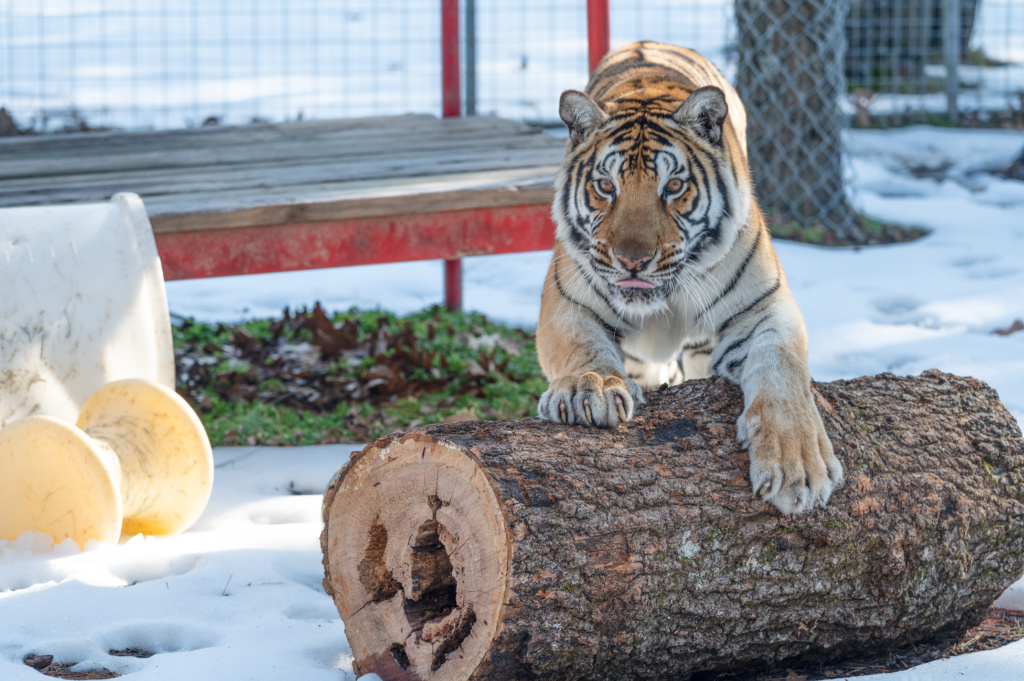
While they don’t usually change color with the seasons, many large cats do grow noticeably thicker, longer fur in colder months. Their coats feel heavier and fluffier to the eye, and tigers especially may appear “puffed out” compared to their summer sleekness.
In sanctuary care, we help them make the most of these natural adaptations by providing heated dens with woodchip bedding and adjusting their diets as the colder months begin.
Even though many of our residents were born in captivity and never roamed the wild, their bodies still carry the ancient programming that says, “Shorter days? Time to grow the winter gear.”