

A cardboard box covered in cinnamon. A frozen block of meat on a hot summer afternoon. A new Boomer Ball rolling across the grass. The unfamiliar scent of a cologne sprayed somewhere in a habitat.
To us, these may seem like simple objects or smells. To a rescued wild cat at Turpentine Creek Wildlife Refuge, they can transform an ordinary day into an opportunity to investigate, explore, play, problem-solve, and engage instincts that have been shaped over thousands of years.
This is enrichment—and it is an essential part of providing exceptional lifetime care to wild animals in captivity.
At Turpentine Creek Wildlife Refuge (TCWR), enrichment is not something we provide occasionally as a special treat. It is a carefully planned, robust, and regimented part of our animal care program. Every day, our team considers the physical, behavioral, and medical needs of the animals in our care and looks for safe ways to make their environments interesting, stimulating, and engaging.
For animals rescued from the exotic pet trade, roadside zoos, breeding operations, and other situations of exploitation and neglect, those opportunities can be especially meaningful.
The Science Behind Enrichment and Animal Welfare
Environmental enrichment is broadly used in professional animal care to provide opportunities for animals to express species-appropriate behaviors, make choices, investigate their surroundings, forage, play, solve problems, and interact with a changing environment.
These opportunities matter because captivity fundamentally changes the environment available to a wild animal. In nature, an animal’s day is filled with decisions and changing stimuli. Where should it travel? What does that smell mean? Where will it find food? Is another animal nearby? Has something changed within its territory?
Scientific research has repeatedly demonstrated the importance of creating opportunities for animals in captivity to engage with their surroundings.
A review of zoo animal welfare science describes abnormal repetitive behaviors, often called stereotypies, as behaviors that can arise from factors including frustration, attempts to adapt to an environment, or neurological dysfunction. Because behavior is only one component of welfare, scientists emphasize evaluating the animal as a whole rather than relying on any single behavior as proof of good or poor welfare.
Research on environmental enrichment has nevertheless found important welfare benefits. Enrichment can encourage exploration, foraging, activity, play, problem-solving, and other species-appropriate behaviors, while studies across multiple species have documented reductions in stereotypic behaviors and other indicators associated with poor welfare. Research also shows why enrichment programs must be thoughtfully designed: different animals can respond differently to the same enrichment, and novelty can diminish as animals become accustomed to an item.
For wild cats in particular, scent can be an incredibly valuable tool. A study of captive black-footed cats found that introducing novel odors—including catnip, nutmeg, and prey scent—increased movement and exploration while decreasing sedentary behavior. Researchers also observed that the cats’ responses diminished after repeated exposure, reinforcing the importance of providing variety rather than simply offering the same stimulus again and again.
Research with captive jaguarundis has similarly demonstrated that sensory enrichment can increase exploratory behavior, further supporting the role of carefully selected enrichment in meeting the behavioral needs of wild felids.
The science reinforces something our animal care team sees every day: good enrichment is not simply about giving an animal something to play with. It is about giving that animal opportunities to engage with its environment.
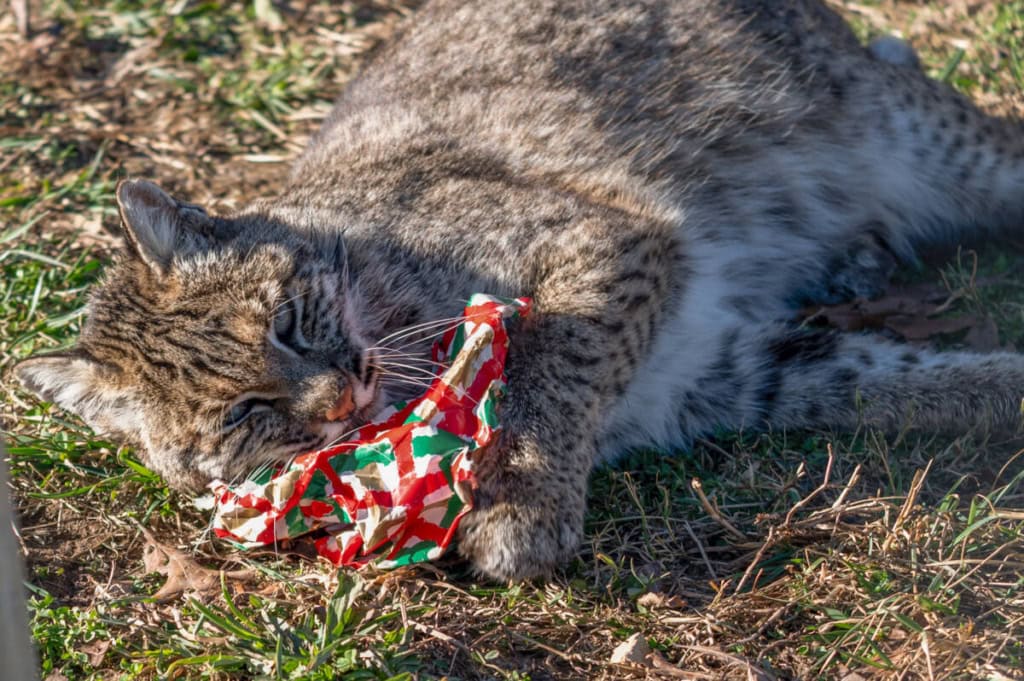
Enrichment Is Individualized Care
At Turpentine Creek, every animal is an individual.
That principle is particularly important because many of the animals who arrive at the Refuge have medical conditions resulting from or commonly associated with the exotic wildlife trade. Years of inappropriate nutrition, breeding, inadequate veterinary care, or unsuitable living conditions can leave permanent effects.
Some of the animals in our care live with skeletal deformities, digestive problems, mobility limitations, or other chronic medical concerns. Those conditions influence nearly every aspect of their care—including enrichment.
For example, certain animals with digestive or skeletal concerns may require carefully controlled diets, including boneless meat diets. For those individuals, our animal care team must make sure enrichment cannot be torn apart and swallowed in a way that could create an additional medical problem.
An enrichment item that is perfectly appropriate for one tiger may not be appropriate for another.
That is why our enrichment program is regimented, monitored, and individualized. Our team considers the animal, its medical history, its behavior, its diet, and the enrichment itself before deciding what is appropriate.
Providing sanctuary does not simply mean providing food, water, and shelter. Lifetime sanctuary means adapting care to the individual animal for the rest of their life.
A New Smell Can Change an Entire Habitat
One of the simplest forms of enrichment is also one of the most fascinating: scent.
Wild cats experience the world through senses that are far more powerful than our own. Smell provides information about their surroundings, other animals, resources, and changes within their environment.
In the wild, a tiger, lion, leopard, serval, bobcat, or other wild feline may move through a large home range while searching for food, water, mates, territory, and other resources. Every portion of that landscape carries information.
Although no captive environment can recreate the enormous territories these animals would experience in nature, enrichment allows us to introduce some of that novelty and unpredictability into their daily lives.
That is why our animal care team uses approved household spices, perfumes, colognes, herbs, and other scents throughout our habitats. Cinnamon, basil, oregano, sage, cumin, paprika, catnip, and even familiar perfumes can become something completely new when a wild cat encounters them.
The response can be immediate.
A cat may stop, lift its nose, investigate, rub against the scented object, roll on the ground, or follow the scent throughout the habitat.
For that animal, the habitat has suddenly changed—and there is something new to investigate.
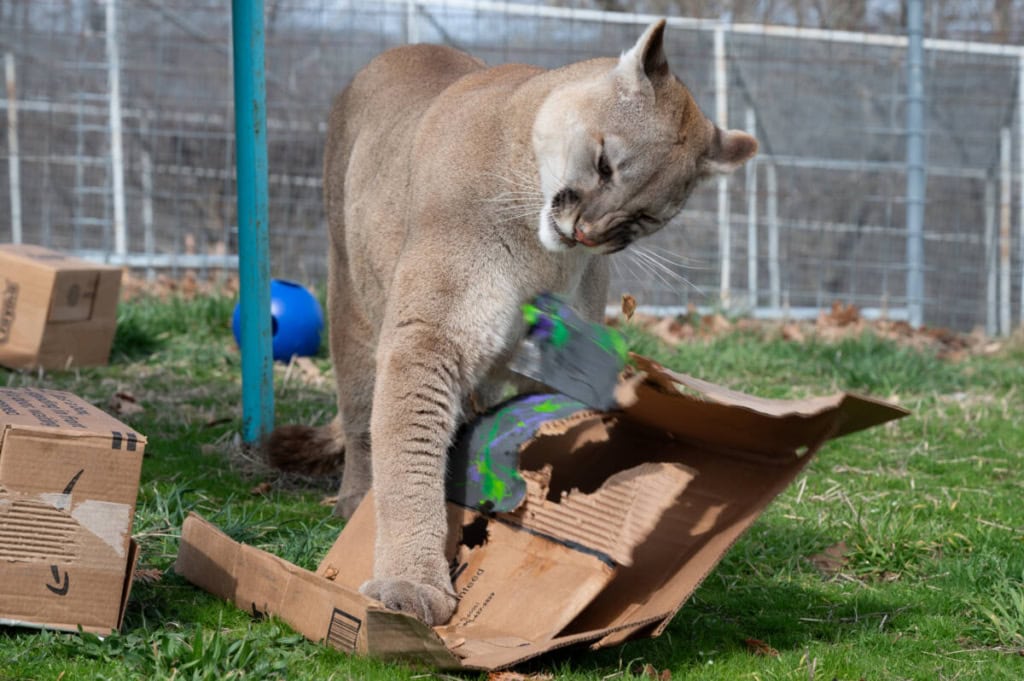
TCWR’s enrichment program accepts a variety of household scent items for exactly this reason, including approved spices, perfumes, colognes, boxes, paper products, and other materials that can encourage exploration and problem-solving.
Permanent enrichment items such as Boomer Balls, tires, bobbins, platforms, pools, and other durable objects give animals opportunities to manipulate their surroundings, play, climb, push, carry, stalk, pounce, or simply investigate something different. Our animals can be incredibly hard on their toys, which means even products specifically designed for large carnivores eventually need to be replaced.
That destruction isn’t necessarily a bad thing.
A tiger pushing, biting, stalking, chasing, and wrestling with an enrichment object is making choices and physically interacting with its environment. The goal isn’t to keep a toy pristine. The goal is to give the animal an appropriate outlet for natural behaviors.

When the Seasons Become Enrichment
Some of our most memorable enrichment comes from items people normally associate with their own holiday traditions.
After Halloween, pumpkins can become enrichment.
After Thanksgiving, whole turkeys can offer appropriate animals a different feeding experience.
After Christmas, approved Christmas trees can bring an entirely new collection of textures and scents into a habitat.
Much of this enrichment can come from donated surplus or overstock that would otherwise go unused as human demand for these seasonal items ends.
Something that has reached the end of its usefulness to us can become an extraordinary new experience for a rescued animal.
A Christmas tree, for example, is not simply a tree when it enters a tiger’s habitat. It is hundreds of unfamiliar smells and textures arriving all at once. It can be rubbed against, investigated, rolled on, dragged, marked, or—in true tiger fashion—completely rearranged.
These temporary enrichment opportunities help us continually introduce novelty into the lives of animals whose needs extend far beyond the basics of survival.
Enrichment Is Part of Our Mission
Turpentine Creek Wildlife Refuge exists to provide lifetime sanctuary for survivors of the exotic animal trade while advocating for an end to the private ownership and exploitation of big cats and other wild animals.
Many of the animals who come through our gates have already experienced what happens when those needs are ignored.
Some were confined in spaces that could never accommodate their natural behaviors. Others suffered from improper nutrition, insufficient veterinary care, irresponsible breeding, or environments designed around entertainment and human convenience rather than animal welfare.
Rescue changes where an animal lives.
Sanctuary changes how that animal is allowed to live.
That distinction matters.
Our responsibility does not end when the rescue trailer pulls through the gates. It continues every morning when diets are prepared, every time medications are administered, every habitat that is cleaned and maintained, every veterinary exam, every behavioral observation—and every piece of enrichment selected for an individual animal.
Enrichment is one more way we give the animals in our care opportunities to make choices, investigate their surroundings, exercise their bodies and minds, and simply be wild animals without being asked to perform for people.
Help Make Their Day
Now, you can be part of that care.
Turpentine Creek Wildlife Refuge has launched a dedicated Enrichment Page, where supporters can help provide enrichment for the rescued animals who call the Refuge home.
You can help purchase durable enrichment toys such as Boomer Balls, contribute toward temporary enrichment like scents and treats, or see the everyday household items our animal care team can use to create new experiences. Donations can support the animal most in need, and supporters interested in providing a toy for a specific resident can contact our Enrichment Coordinator to determine what is appropriate for that individual.
A new scent may last only a day.
A cardboard box may last only a few minutes.
A Boomer Ball may eventually meet a very determined tiger.
But for that animal, enrichment creates something invaluable: a new experience, a new choice, and a reason to explore.
Help us make the best day possible for an animal you care about.
Give the gift of enrichment today.